AI and machine learning are reshaping healthcare, from predicting hospital readmissions and automating prior authorizations to extracting structured data from clinical notes. But the models themselves are only half the story. The harder problem — and the one that determines whether an AI initiative succeeds or fails — is getting the right data to the model in the right format, at the right time, without violating patient privacy.
Building robust, compliant data pipelines from clinical source systems to AI/ML platforms is the critical infrastructure that makes healthcare AI possible. This guide walks through the architecture, standards, tools, and compliance considerations required to build these pipelines, drawing on practical patterns we use in production healthcare environments.
The Healthcare AI Data Challenge
Healthcare data is uniquely difficult to work with compared to other industries. Understanding these challenges upfront is essential for designing pipelines that actually work.
Fragmentation Across Systems
A single patient’s data may be spread across a dozen or more systems: the EHR holds clinical notes and orders, the laboratory information system (LIS) holds lab results, the radiology information system (RIS) holds imaging reports, the pharmacy system holds medication dispensing records, the claims system holds billing and diagnosis data, and wearable devices generate continuous physiological measurements. Each system has its own data model, its own API (or lack thereof), and its own access controls.
Multiple Data Formats
Healthcare has no single data standard. You will encounter HL7 v2 pipe-delimited messages for real-time clinical events, FHIR JSON resources for modern API-based access, C-CDA XML documents for clinical document exchange, X12 EDI transactions for claims and eligibility, DICOM for medical imaging, and countless proprietary CSV and flat-file exports. Any AI pipeline must normalize across these formats.
Privacy Constraints
HIPAA’s Privacy Rule governs how protected health information (PHI) can be used, and the Minimum Necessary Standard requires that only the data elements actually needed for a given purpose be accessed. For AI model training, this almost always means de-identification is required. De-identification is not a simple find-and-replace operation — it requires systematic removal of 18 categories of identifiers under the Safe Harbor method, or a statistical certification under Expert Determination.
Data Quality Issues
Clinical data is messy. Diagnoses are coded inconsistently across providers, free-text fields contain abbreviations and misspellings, lab values may use different units across systems, timestamps may reflect order time versus collection time versus result time, and duplicate patient records are common. AI models trained on uncleaned clinical data will produce unreliable results.
Scale
A mid-sized health system generates millions of clinical observations, notes, orders, and results per year. A population health analytics pipeline might need to process data for hundreds of thousands of patients across a decade of history. The pipeline architecture must handle this volume efficiently.
Pipeline Architecture
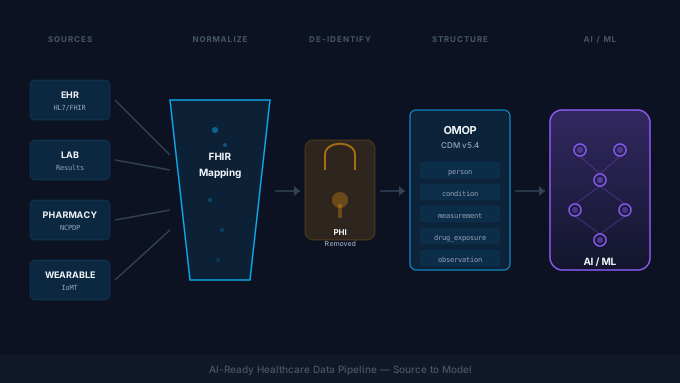
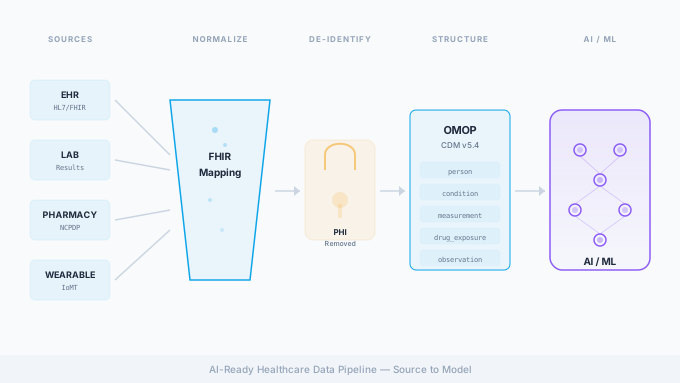
A production-grade healthcare AI data pipeline follows a layered architecture. Each layer has a distinct responsibility, and the separation of concerns makes the system maintainable, auditable, and compliant.
Layer 1: Source Systems
The pipeline begins at the clinical source systems where data originates:
- EHR systems (Epic, Oracle Health, athenahealth) — clinical notes, orders, results, demographics
- Laboratory information systems — lab results, specimen tracking
- Imaging systems (PACS, RIS) — radiology reports, DICOM images
- Pharmacy systems — medication dispensing, formulary data
- Claims/billing systems — diagnosis codes, procedure codes, payer data
- Medical devices and wearables — continuous vitals, remote patient monitoring data
Layer 2: Integration Layer
The integration layer extracts data from source systems and normalizes it into a consistent format. This is where integration engines like Mirth Connect (NextGen Connect) or cloud-based integration platforms do the heavy lifting.
Key extraction patterns:
- Real-time feeds: HL7 v2 ADT/ORU/ORM messages over MLLP (Minimal Lower Layer Protocol) for live clinical events
- FHIR REST APIs: Individual resource queries or Bulk FHIR export for large datasets
- Database extracts: Direct SQL queries against EHR reporting databases (where permitted and governed by BAAs)
- File-based ingestion: sFTP drops of CSV, flat files, or C-CDA documents
The integration layer transforms incoming data into FHIR resources regardless of the source format. This creates a uniform representation that downstream layers can depend on.
Layer 3: Data Lake / Staging
Raw and transformed data lands in cloud object storage (Amazon S3, Azure Blob Storage, or Google Cloud Storage) organized by source system, data type, and ingestion date. This staging layer serves as the system of record for all data that enters the pipeline.
Key considerations:
- Encryption at rest (AES-256) and in transit (TLS 1.2+)
- Access controls aligned with HIPAA requirements
- Data retention policies that match organizational and regulatory requirements
- Immutable audit logs for all data access
Layer 4: Transformation Layer
The transformation layer converts staged FHIR resources into analytics-ready formats. The most common target is the OMOP Common Data Model (CDM), which standardizes clinical data using controlled vocabularies.
Layer 5: AI/ML Platform
The transformed, de-identified data feeds into ML training pipelines, model evaluation frameworks, and inference engines. Common platforms include Amazon SageMaker, Azure Machine Learning, Google Vertex AI, and open-source frameworks like MLflow.
Layer 6: Output Layer
Model predictions and insights flow back into clinical workflows through:
- CDS Hooks: FHIR-based clinical decision support alerts surfaced in the EHR
- SMART on FHIR apps: Embedded applications within the EHR that display AI-generated insights
- API endpoints: RESTful services that other systems can query for predictions
- Reporting dashboards: Population health analytics and operational intelligence
FHIR as the Foundation
FHIR (Fast Healthcare Interoperability Resources) is the ideal data source for AI pipelines for several reasons: it is structured, standardized, widely adopted, and purpose-built for modern API-based data access.
Why FHIR Works for AI
Structured resources: FHIR represents clinical data as typed resources (Patient, Observation, Condition, MedicationRequest, Procedure, etc.) with well-defined fields. Unlike free-text clinical notes or semi-structured HL7 v2 messages, FHIR resources parse cleanly into structured datasets.
Standardized coding: FHIR resources use standard terminologies — SNOMED CT for clinical findings, LOINC for lab observations, RxNorm for medications, ICD-10 for diagnoses. This standardization reduces the mapping work needed before data can feed a model.
US Core profiles: The US Core Implementation Guide constrains FHIR resources to meet US regulatory requirements, ensuring consistency across EHR vendors. If data conforms to US Core, you know exactly which fields will be populated and how.
Bulk FHIR export: The Bulk Data Access specification (FHIR Bulk Export) enables efficient extraction of large datasets. Instead of querying resources one at a time, you can request an export of all Patients, Observations, and Conditions for an entire population and receive the data as NDJSON (newline-delimited JSON) files.
Example: Extracting Data for a Diabetes Prediction Model
Suppose you are building a model to predict Type 2 diabetes risk. You need patient demographics, lab results (HbA1c, fasting glucose), BMI measurements, medication history, and existing conditions. Here is how you would extract this data using FHIR:
# Initiate a Bulk FHIR export for the target population# This requests Patient, Observation, Condition, and MedicationRequest resourcesPOST https://fhir.example.org/fhir/$exportContent-Type: application/fhir+jsonAccept: application/fhir+jsonPrefer: respond-async
{  "resourceType": "Parameters",  "parameter": [    {      "name": "_type",      "valueString": "Patient,Observation,Condition,MedicationRequest"    },    {      "name": "_typeFilter",      "valueString": "Observation?code=4548-4,2345-7,39156-5"    }  ]}
The _typeFilter parameter restricts Observations to specific LOINC codes: 4548-4 (HbA1c), 2345-7 (fasting glucose), and 39156-5 (BMI). This applies the Minimum Necessary Standard by requesting only the data elements needed for the model.
The export produces NDJSON files that can be loaded directly into a data processing framework:
import jsonimport pandas as pd
# Parse exported FHIR Observation resourcesobservations = []with open("Observation.ndjson", "r") as f:    for line in f:        resource = json.loads(line)        obs = {            "patient_id": resource["subject"]["reference"].split("/")[1],            "code": resource["code"]["coding"][0]["code"],            "display": resource["code"]["coding"][0]["display"],            "value": resource.get("valueQuantity", {}).get("value"),            "unit": resource.get("valueQuantity", {}).get("unit"),            "date": resource.get("effectiveDateTime"),            "status": resource.get("status")        }        observations.append(obs)
df = pd.DataFrame(observations)print(f"Loaded {len(df)} observations for {df['patient_id'].nunique()} patients")
FHIR Subscriptions for Real-Time Feeds
For AI models that need real-time or near-real-time data (such as clinical decision support or deterioration prediction), FHIR Subscriptions provide a publish-subscribe mechanism. You define a subscription topic (e.g., “new lab result for patient X”) and the FHIR server pushes matching resources to your pipeline endpoint as they are created or updated. This is significantly more efficient than polling.
ETL: FHIR to OMOP CDM
The OMOP Common Data Model, maintained by the OHDSI (Observational Health Data Sciences and Informatics) community, is the gold standard for observational health data analytics. Converting FHIR data to OMOP CDM standardizes vocabularies, normalizes data structures, and produces a dataset format that is compatible with thousands of existing analytics packages and published studies.
Why OMOP for AI
OMOP provides several advantages over raw FHIR data for ML workloads:
- Standardized vocabularies: All diagnoses map to SNOMED CT concepts, all drugs map to RxNorm, all measurements map to LOINC. This eliminates the variability of source coding systems.
- Person-centric model: OMOP organizes all data around a
persontable, making it straightforward to construct patient-level feature sets for ML. - Research compatibility: Published studies, phenotype definitions, and cohort algorithms from the OHDSI community can be applied directly to OMOP-formatted data.
- Temporal structure: OMOP tables include standardized date fields that support time-series analysis, a common requirement for clinical prediction models.
Key OMOP Tables
| Table | Contains | Example Use in AI |
|---|---|---|
person | Demographics (year of birth, gender, race, ethnicity) | Patient-level features |
condition_occurrence | Diagnoses with start/end dates | Disease history features |
measurement | Lab results, vital signs with values and units | Numeric input features |
drug_exposure | Medications with start/end dates and dosage | Treatment history features |
procedure_occurrence | Procedures performed | Surgical history features |
observation | Other clinical observations | Additional clinical context |
visit_occurrence | Encounters/visits with dates and types | Utilization features |
FHIR-to-OMOP Mapping Patterns
The mapping from FHIR resources to OMOP tables is conceptually straightforward but has practical challenges:
- FHIR Patient maps to OMOP
person: Extract birth year, gender concept, race/ethnicity from US Core extensions. - FHIR Condition maps to OMOP
condition_occurrence: Map the Condition.code (usually ICD-10 or SNOMED) to a standard OMOP concept_id using the OMOP vocabulary tables. - FHIR Observation (labs/vitals) maps to OMOP
measurement: Map LOINC codes to OMOP concept_ids, convert units to standard units if needed. - FHIR MedicationRequest maps to OMOP
drug_exposure: Map RxNorm codes to OMOP concept_ids, calculate drug exposure duration from dispense records.
Common challenges:
- Concept mapping: Source codes (e.g., local lab codes) may not map directly to standard vocabularies. Building and maintaining a concept mapping table is an ongoing effort.
- Date handling: FHIR uses ISO 8601 dates with varying precision (date-only, datetime, datetime with timezone). OMOP expects dates in specific formats. Your ETL must handle all variations.
- Missing data: Not all FHIR resources contain all expected fields. Your pipeline must handle missing values gracefully — either imputing, flagging, or excluding incomplete records.
Tools like the OHDSI ETL frameworks, the FHIR-to-OMOP projects on GitHub, and custom Apache Spark or dbt pipelines are commonly used for this transformation.
NLP for Unstructured Clinical Data
An estimated 80% of healthcare data exists as unstructured text: clinical notes, discharge summaries, radiology reports, pathology reports, operative notes, and patient communications. AI pipelines that ignore unstructured data are working with only a fraction of the available clinical signal.
NLP Pipeline Components
A clinical NLP pipeline typically includes these stages:
-
Text extraction: Pulling raw text from source systems. Clinical notes may arrive as HL7 OBX segments (in ORU or MDM messages), FHIR DocumentReference resources, C-CDA documents, or database extracts.
-
Section detection: Clinical notes follow predictable structures (Chief Complaint, History of Present Illness, Assessment, Plan). Section detection identifies these boundaries so that downstream analysis can be context-aware. A medication mentioned in the “Past Medical History” section has different significance than one in the “Current Medications” section.
-
Named entity recognition (NER): Identifying clinical entities in the text — diagnoses, medications, procedures, anatomical locations, lab values, and temporal expressions.
-
Relation extraction: Determining relationships between entities. For example, linking a medication to a dosage and route, or connecting a diagnosis to a body site.
-
Negation detection: Critically important in clinical text. “Patient denies chest pain” and “Patient reports chest pain” have opposite clinical meanings, but both contain the entity “chest pain.” Negation detection algorithms (such as NegEx or its successors) classify whether an entity is affirmed, negated, or uncertain.
-
Normalization: Mapping extracted entities to standard vocabularies (SNOMED CT, RxNorm, ICD-10) so they can be integrated with structured data in the OMOP CDM or other analytics frameworks.
Tools and Frameworks
spaCy + scispaCy: spaCy is a production-grade Python NLP library, and scispaCy extends it with biomedical language models, entity linkers for UMLS concepts, and pre-trained pipelines for clinical text. This is a strong choice for teams that want full control over their NLP pipeline.
import spacyimport scispacyfrom scispacy.linking import EntityLinker
# Load the biomedical NER modelnlp = spacy.load("en_ner_bc5cdr_md")nlp.add_pipe("scispacy_linker", config={    "resolve_abbreviations": True,    "linker_name": "umls"})
clinical_note = """ASSESSMENT: Patient is a 62-year-old male with newly diagnosedtype 2 diabetes mellitus (HbA1c 8.2%). He also has a history ofhypertension controlled on lisinopril 20mg daily.No evidence of diabetic retinopathy on fundoscopic exam."""
doc = nlp(clinical_note)for entity in doc.ents:    print(f"Entity: {entity.text}")    print(f"  Label: {entity.label_}")    if entity._.kb_ents:        cui, score = entity._.kb_ents[0]        print(f"  UMLS CUI: {cui} (confidence: {score:.2f})")    print()
Cloud NLP services: AWS Comprehend Medical, Azure Text Analytics for Health, and Google Cloud Healthcare Natural Language API provide managed NLP services that extract medical entities, relationships, and attributes from clinical text. These services handle the infrastructure complexity but require that data be sent to the cloud provider, which has HIPAA implications (a BAA with the provider is required).
Hugging Face medical models: The Hugging Face model hub hosts specialized medical language models including BioBERT, ClinicalBERT, PubMedBERT, and GatorTron. These can be fine-tuned for specific clinical NLP tasks and run on-premises to avoid sending PHI to external services.
De-identification Before NLP
Before any clinical text enters an NLP pipeline — especially one that feeds into AI model training — PHI must be removed. HIPAA provides two de-identification methods:
Safe Harbor: Remove all 18 categories of identifiers, including names, dates (except year), geographic data smaller than state, phone numbers, email addresses, SSNs, MRNs, and any other unique identifying numbers. Dates can be shifted by a consistent random offset per patient to preserve temporal relationships while removing the actual dates.
Expert Determination: A qualified statistician certifies that the risk of re-identification is “very small.” This method allows more data to be retained but requires statistical expertise and documentation.
For NLP pipelines, automated de-identification tools can detect and redact PHI in clinical text before it is processed. Tools include Philter, Scrubadub (with its clinical extensions), and the de-identification capabilities built into AWS Comprehend Medical.
LLM Integration Patterns
Large language models are opening new possibilities in healthcare, but integrating LLMs into clinical workflows requires careful attention to accuracy, privacy, and regulatory requirements.
Use Cases for LLMs in Healthcare
Clinical summarization: Condensing lengthy clinical notes, discharge summaries, or multi-visit histories into concise summaries for physician review. This saves clinicians time without replacing their judgment.
Medical coding assistance: Analyzing clinical documentation and suggesting appropriate ICD-10 diagnosis codes and CPT procedure codes. Human coders review and validate the suggestions, improving coding speed and consistency.
Prior authorization automation: Processing prior authorization requests by extracting clinical justification from documentation and matching it against payer medical policies. This can reduce authorization turnaround time from days to hours.
Patient communication: Generating patient-friendly explanations of clinical results, medication instructions, and care plans. The generated text is reviewed by clinical staff before being sent to patients.
Challenges and Mitigations
Hallucination risk: LLMs can generate plausible-sounding but factually incorrect clinical information. In healthcare, hallucinated drug interactions, fabricated lab values, or invented clinical guidelines can cause patient harm. Mitigation strategies include RAG (Retrieval Augmented Generation), human-in-the-loop review, and confidence scoring.
PHI handling: LLMs must never be trained on or prompted with identifiable patient data unless the model runs within a HIPAA-compliant environment with appropriate BAAs in place. For cloud-hosted LLMs, this means using HIPAA-eligible configurations and ensuring PHI is de-identified before it enters the prompt.
Model validation: Healthcare AI applications may fall under FDA regulation depending on their intended use. Clinical decision support tools that are intended to diagnose, treat, or prevent disease may require 510(k) clearance or De Novo authorization. Validation should include performance testing on representative clinical populations, bias analysis across demographic groups, and ongoing monitoring after deployment.
RAG Pattern for Clinical Knowledge
Retrieval Augmented Generation (RAG) is the most practical pattern for reducing LLM hallucinations in healthcare applications. Instead of relying on the LLM’s parametric knowledge, you retrieve relevant context from a curated knowledge base and include it in the prompt.
from langchain.vectorstores import Chromafrom langchain.embeddings import HuggingFaceEmbeddingsfrom langchain.llms import AzureOpenAI
# Build a vector store from clinical guidelines and formulary dataembeddings = HuggingFaceEmbeddings(model_name="pritamdeka/BioBERT-mnli-snli-scinli-scitail-mednli-stsb")vectorstore = Chroma.from_documents(    documents=clinical_guidelines,  # pre-loaded clinical guideline chunks    embedding=embeddings,    persist_directory="./clinical_kb")
# At query time, retrieve relevant context and augment the promptdef generate_clinical_summary(patient_data: dict, query: str) -> str:    # Retrieve relevant clinical guidelines    relevant_docs = vectorstore.similarity_search(query, k=3)    context = "\n".join([doc.page_content for doc in relevant_docs])
    prompt = f"""Based on the following clinical guidelines and patient data,    provide a clinical summary. Only include information supported by the    provided context. If uncertain, state that explicitly.
    CLINICAL GUIDELINES:    {context}
    PATIENT DATA (de-identified):    {patient_data}
    QUERY: {query}    """
    llm = AzureOpenAI(deployment_name="gpt-4", temperature=0)    return llm(prompt)
This pattern grounds the LLM’s response in authoritative clinical sources, reducing the risk of hallucinated clinical information.
Real-World Examples
These examples illustrate how the pipeline architecture described above applies to concrete healthcare AI use cases.
Prior Authorization Automation
A health system receives thousands of prior authorization requests per week. Each request requires a clinical reviewer to read the patient’s chart, extract relevant clinical information, compare it against the payer’s medical policy, and render a determination.
Pipeline implementation:
- Extract relevant clinical data via FHIR (Condition, Procedure, MedicationRequest, DiagnosticReport)
- Apply NLP to clinical notes to identify supporting clinical justification
- Structure extracted data into a feature set matching the payer’s medical policy criteria
- ML model predicts approval likelihood based on clinical evidence and historical outcomes
- Cases with high-confidence predictions (above 95%) are auto-routed for expedited processing
- Cases below the confidence threshold are queued for human clinical review with pre-extracted evidence summaries
Impact: Reduces average authorization turnaround from 3-5 days to under 24 hours for high-confidence cases, while maintaining human oversight for complex decisions.
Clinical Decision Support: Sepsis Early Warning
A real-time deterioration model monitors inpatient vital signs, lab results, and clinical documentation to predict sepsis onset 4-6 hours before clinical recognition.
Pipeline implementation:
- Real-time HL7 v2 ADT and ORU messages feed into Mirth Connect
- Mirth transforms messages to FHIR Observation resources and publishes to a streaming platform (Kafka)
- A streaming ML pipeline consumes FHIR resources, computes features (vital sign trends, lab trajectories, comorbidity burden), and runs inference
- Predictions above the alert threshold trigger a CDS Hooks alert in the EHR
- The alert displays the predicted risk score, the contributing factors, and recommended interventions
Key technical detail: The model requires time-series features (e.g., rate of change in heart rate over the past 2 hours, trend in white blood cell count). The streaming pipeline maintains a per-patient state window that accumulates recent observations and recomputes features with each new data point.
Population Health: Readmission Risk Stratification
A health system wants to identify patients at high risk of 30-day readmission at the time of discharge so that care coordinators can intervene with transitional care services.
Pipeline implementation:
- Bulk FHIR export extracts 3 years of historical data (encounters, conditions, medications, labs, procedures)
- FHIR-to-OMOP ETL standardizes the data into the OMOP CDM
- Feature engineering produces patient-level features: number of admissions in prior 12 months, number of active chronic conditions, medication count, most recent lab abnormalities, social determinant indicators
- A gradient boosting model (XGBoost) trained on historical readmission outcomes predicts risk at discharge
- Risk scores are written back to the EHR via FHIR and surfaced in the discharge planning workflow
Medical Coding Assistance
A revenue cycle team processes hundreds of inpatient charts per day. Coders read clinical documentation, identify diagnoses and procedures, and assign appropriate ICD-10 and CPT codes.
Pipeline implementation:
- MDM messages (clinical documents) are extracted via the integration layer
- NLP pipeline extracts clinical entities: diagnoses, procedures, laterality, severity
- Entity normalization maps extracted terms to ICD-10-CM and CPT candidate codes
- LLM (via RAG pattern with coding guidelines) ranks candidate codes by relevance and generates coding rationale
- Human coders review suggested codes, accept or modify, and submit final coding
- Feedback loop: coder corrections are logged and used to improve model accuracy over time
Data Privacy and Compliance
Every layer of a healthcare AI pipeline must be designed with HIPAA compliance in mind. This is not optional, and it is not something you bolt on after the fact.
De-Identification Methods
Safe Harbor (18 identifiers): Remove or generalize these categories: names, geographic data (except state), dates (except year) related to an individual, phone numbers, fax numbers, email addresses, SSNs, MRNs, health plan beneficiary numbers, account numbers, certificate/license numbers, vehicle identifiers and serial numbers, device identifiers, web URLs, IP addresses, biometric identifiers, full-face photographs, and any other unique identifying number.
Expert Determination: A qualified statistical expert applies statistical and scientific principles to determine that the risk of identifying any individual is “very small.” This method allows more granular data to be retained (e.g., exact dates, partial geographic data) but requires documented methodology and ongoing risk assessment.
For AI training datasets, Safe Harbor is the more commonly used method because it provides a clear, verifiable checklist. Expert Determination is used when the ML use case requires data elements (like precise dates for time-series modeling) that Safe Harbor would remove.
Minimum Necessary Standard
HIPAA’s Minimum Necessary Standard requires that covered entities limit PHI access to the minimum necessary to accomplish the intended purpose. For AI pipelines, this means:
- Request only the FHIR resource types and fields needed for the model
- Use
_elementsparameters in FHIR queries to restrict returned fields - Apply column-level access controls in the data lake
- Document the data elements used for each model and the justification for each
Business Associate Agreements
Any third-party service that processes, stores, or transmits PHI on behalf of a covered entity must have a BAA in place. For AI pipelines, this includes:
- Cloud infrastructure providers (AWS, Azure, GCP)
- Integration platform vendors
- NLP and LLM service providers
- Data analytics platform vendors
- Model hosting and inference services
All major cloud providers offer HIPAA-eligible services and will execute BAAs, but you must ensure that only HIPAA-eligible services are used for PHI workloads. Not all services within a cloud provider’s portfolio are covered.
Federated Learning
For organizations that cannot or prefer not to centralize patient data, federated learning offers an alternative approach. Instead of moving data to a central location for model training, the model is sent to each data site, trained on local data, and the model updates (not the data) are aggregated centrally.
This approach keeps PHI within each organization’s security boundary while still enabling multi-site model training. Frameworks like NVIDIA FLARE and PySyft support federated learning architectures for healthcare.
Audit Trails and Data Lineage
Regulatory compliance requires knowing exactly what data was used, how it was transformed, and who accessed it. Your pipeline should produce:
- Immutable access logs for all data reads and writes
- Data lineage records showing how each transformed dataset was derived from source data
- Model training provenance: which dataset version, which hyperparameters, which training run produced each model
- Prediction audit logs: for each inference, what input data was used and what prediction was generated
Getting Started
Building a complete healthcare AI pipeline is a multi-phase effort. Here is a practical sequence for getting from zero to a working pilot.
Phase 1: Foundation (weeks 1-4)
- Audit current data sources and identify available extraction methods (FHIR APIs, HL7 feeds, database access)
- Establish a FHIR-based extraction pipeline from the primary EHR using Bulk FHIR export
- Set up cloud infrastructure with HIPAA-compliant configurations and BAAs
- Build a de-identification pipeline and validate it against test data containing synthetic PHI
Phase 2: Structured Data Pipeline (weeks 5-8)
- Implement FHIR-to-OMOP ETL for structured data (labs, vitals, medications, conditions)
- Build feature engineering pipelines for the target use case
- Start with a focused, well-defined use case like readmission risk or medication adherence prediction
- Train initial models on de-identified structured data
Phase 3: Unstructured Data (weeks 9-12)
- Add NLP processing for clinical notes and documents
- Implement de-identification for unstructured text
- Extract structured features from clinical narratives
- Integrate NLP-derived features into the ML feature set
Phase 4: Production Deployment (weeks 13-16)
- Deploy the model to a serving infrastructure with monitoring
- Integrate predictions back into clinical workflows via CDS Hooks or SMART on FHIR
- Implement ongoing monitoring for model drift, data quality, and prediction performance
- Establish feedback loops for continuous model improvement
Next Steps
Building AI-ready healthcare data pipelines requires deep expertise in healthcare data standards, clinical workflows, cloud infrastructure, and regulatory compliance. The architecture described in this guide provides a proven framework, but every organization’s data landscape and use cases are different.
Saga IT helps healthcare organizations design, build, and operate these pipelines:
- Data analytics and AI pipeline development — from architecture design through production deployment, including FHIR extraction, OMOP CDM transformation, and ML platform integration
- MDDS Console — browser-based administration, monitoring, and data exchange for Mirth Connect and OIE
- FHIR API integration — implementing FHIR-based data access from EHRs including Epic, Oracle Health, and athenahealth
- Medical software development — building custom clinical applications, CDS tools, and AI-powered healthcare software
- Mirth Connect integration services — deploying and managing the integration engines that power real-time clinical data pipelines
If you are evaluating healthcare AI opportunities or need help building the data infrastructure to support your ML initiatives, contact Saga IT to discuss your project.